DMCC India Growth: JLT Property Signal
DMCC’s Indian business community has passed 4,080 companies. For Dubai property investors, the signal is not a price forecast, but a way to read JLT, tenant demand and district resilience.
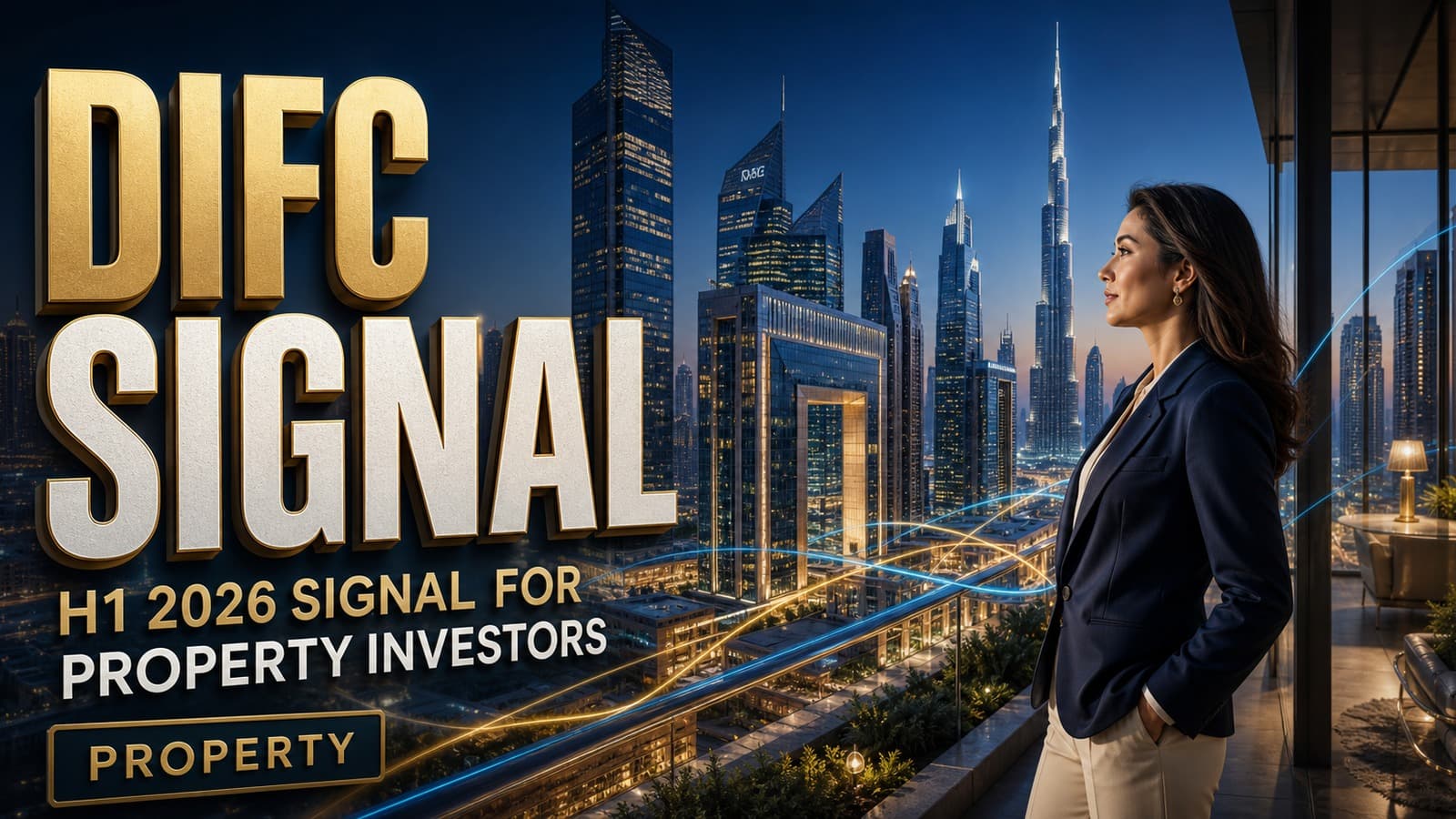
DMCC’s latest India roadshow gives Dubai property investors a useful signal to read: business formation is still strengthening around one of the city’s most established mixed-use districts. The signal is not that every apartment in Jumeirah Lakes Towers should be bought, or that one nationality alone can support a market. The useful point is more disciplined: when a business district keeps attracting companies, it can deepen the tenant base, support office and residential demand, and make the surrounding property market easier to analyse with evidence rather than launch-brochure enthusiasm.
On 5 August 2026, DMCC announced that its Indian business community had surpassed 4,080 companies, after more than 330 Indian businesses joined over the previous 12 months. DMCC described this as 9% growth over the period and said Indian companies now represent more than 15% of its member base. The announcement was made during its Made For Trade Live roadshow in Pune and Mumbai, with DMCC also pointing to stronger UAE-India trade links since CEPA entered into force in 2022.
For Kyora, this deserves a property reading because DMCC is not an abstract free-zone statistic. It is tied to JLT, Uptown Dubai and a wider business ecosystem that sits inside the daily geography of Dubai. Companies bring founders, employees, consultants, suppliers, visiting executives and cross-border families. Some need offices. Some need short-term accommodation. Some become long-term residents. Some eventually buy. That does not turn company registration into automatic property appreciation, but it does make business density a serious district indicator.
Why the signal is different from another market headline
Dubai property news often arrives as price movement, sales volume, launch activity or developer milestones. Those signals matter, but they are not enough. A district can look exciting because new towers are visible, while the underlying demand is still fragile. Another district can look less spectacular but benefit from real employment, trade, services and resident routines. DMCC’s India growth belongs to the second category: it is a demand-quality signal rather than a direct market-price signal.
This is why the article is not redundant with Kyora’s recent notes on developer results, branded towers or Dubai South. Those articles were mainly about developer strength, construction momentum and emerging district narratives. The DMCC signal is about an established business cluster and the foreign-company base that can support daily use. It adds a different layer to investor due diligence: not “what is being built?”, but “who is using the district, why are they there, and how durable is that use?”

What JLT investors should actually examine
JLT has one major advantage in this conversation: it is already lived-in. It combines residential towers, office space, retail, lakes, restaurants, metro access nearby and a strong free-zone identity. That gives investors more evidence to test than a purely future-facing masterplan. The question is not whether JLT is “good” or “bad”. The question is whether a specific building, unit, service-charge profile and entry price are aligned with the district’s real demand.
An investor looking at JLT should start with the building rather than the slogan. Tower quality varies. Maintenance varies. Views vary. Parking, lifts, lobby management, noise, access and service charges can change the real ownership experience. A strong business district does not protect an investor from buying the wrong stack, overpaying for a dated unit, ignoring renovation costs or assuming permanent tenant demand without checking comparable rents.
The DMCC India signal should therefore be used as a context layer. It can justify closer attention to residential units that serve professionals, founders and internationally mobile tenants. It can support interest in layouts that work for singles, couples and small families connected to the business ecosystem. It can also strengthen the case for assets with practical access to offices, metro, restaurants and everyday services. But it should not replace transaction analysis, rent comparisons, vacancy assumptions or building-level checks.
Why Indian company growth matters for Dubai’s long-term story
India is not just a source market for real estate buyers. It is a business corridor, a talent corridor and a family corridor. When Indian companies choose Dubai for regional or international expansion, they contribute to the city’s role as a platform between South Asia, the Gulf, Africa and Europe. This supports the broader Dubai narrative that matters for property: a city is not only a skyline; it is a machine for mobility, business formation and capital connection.
That point matters because Dubai investors can become too focused on visible real estate supply. Supply is essential to monitor, especially in a market with heavy off-plan activity. But demand is not created by towers alone. It comes from jobs, trade, founders, tourism, education, visas, lifestyle and the credibility of public infrastructure. DMCC’s company-growth signal is one of those demand-side indicators. It does not remove cycle risk, but it helps investors understand why certain districts remain relevant after the initial marketing campaign has faded.
The due-diligence frame
A prudent buyer should translate the signal into questions. Is the unit competing for tenants who actually work in or around JLT and DMCC? Is the rent assumption based on comparable signed leases or optimistic listings? Are service charges low enough to preserve net yield? Is the building attractive enough for international tenants who compare Dubai Marina, JLT, Business Bay, Downtown and newer waterfront districts? Is the exit market broad, or dependent on one narrow buyer profile?
The same discipline applies to investors considering nearby districts. A business cluster can influence demand beyond its exact boundaries, but distance still matters. A commute that looks short on a map may feel different at peak hours. A tower marketed as “near DMCC” may not offer the daily convenience implied by the sales pitch. Investors should test walking routes, metro access, parking, road friction and the real lifestyle pattern of the target tenant.
How Kyora reads the opportunity
The attractive reading is clear: Dubai continues to convert international business flows into real urban demand. DMCC’s Indian company growth reinforces the idea that parts of Dubai’s property market are supported by more than speculative launch momentum. For JLT, that is especially relevant because the district already has a functioning residential and commercial ecosystem.
The disciplined reading is just as important. Strong macro or business signals do not make every unit a good investment. In a more selective Dubai market, the winners are likely to be assets where the district thesis, building quality, acquisition price, service charges and tenant profile all work together. The India-DMCC signal should put JLT and nearby business-linked residential assets back on the investor checklist. It should not make investors skip the checklist.
Investor checklist before acting on the signal
Before using this news in a buying decision, Kyora would check five points. First, the building’s service-charge history and maintenance quality. Second, recent transaction prices and actual rental comparables, not only advertised yields. Third, the tenant profile: professionals, founders, executives, families, short-stay demand or mixed demand. Fourth, liquidity: how many comparable units compete in the same tower and nearby towers. Fifth, exit logic: who is likely to buy the unit again in three to seven years, and why?
If those checks are positive, the DMCC India signal becomes useful context. If they are weak, the signal remains interesting for Dubai’s reputation but insufficient for the asset. That distinction is where serious property analysis begins.
Sources and useful references
- DMCC — 9% growth in Indian companies and Made For Trade Live roadshow in Pune and Mumbai.
- JLT official destination website, for district context and daily-use positioning.
- Dubai Land Department open data, useful for checking transaction context before relying on market claims.
- Inline image: DMCC official event photo from the Made For Trade Live Mumbai roadshow page.
Company-registration figures, market data, rents, fees and district conditions can change. Investors should recheck official sources, building documents and transaction comparables before committing capital. This article is editorial analysis, not personalised financial advice.